Roofline strengthens its commitment to IREE as CTO becomes TSC Chair
On 20 August 2026, Roofline CTO Maximilian Bartel became Chair of IREE’s Technical Steering Committee (TSC), building on Roofline’s ongoing contributions to the open-source compiler and runtime project.
In this role, Maximilian helps coordinate the TSC’s work and presides over its meetings. Technical oversight remains with the TSC collectively. Roofline will continue to support IREE through engineering contributions, community participation, and efforts to grow the ecosystem.
IREE remains an open-source project within the LF AI & Data Foundation, which supports open-source AI and data projects under the Linux Foundation.
Key takeaways
- We're strengthening our commitment to IREE, building on our existing contributions and our MLIR- and IREE-based edge AI deployment infrastructure
- Maximilian Bartel, our CTO, is serving as Chair of the IREE Technical Steering Committee
- IREE remains an open-source LF AI & Data Foundation project, with technical oversight through its TSC and open community participation
- We want to help grow an inclusive IREE ecosystem, with broader participation from semiconductor and IP companies, research organizations, and technical contributors working on AI deployment infrastructure
IREE is established open-source infrastructure
Since 2019, the IREE project has developed an MLIR-based compiler and runtime for machine learning deployment. Its architecture supports targets ranging from data center systems to mobile and edge devices through a common compiler and runtime foundation.
IREE joined the LF AI & Data Foundation as a sandbox-stage project in May 2024. As of October 2026, LFX Insights records 1,313 contributors across the project, while the main IREE repository has almost 4,000 GitHub stars and over 1,000 forks.
Why we’re deepening our commitment to IREE
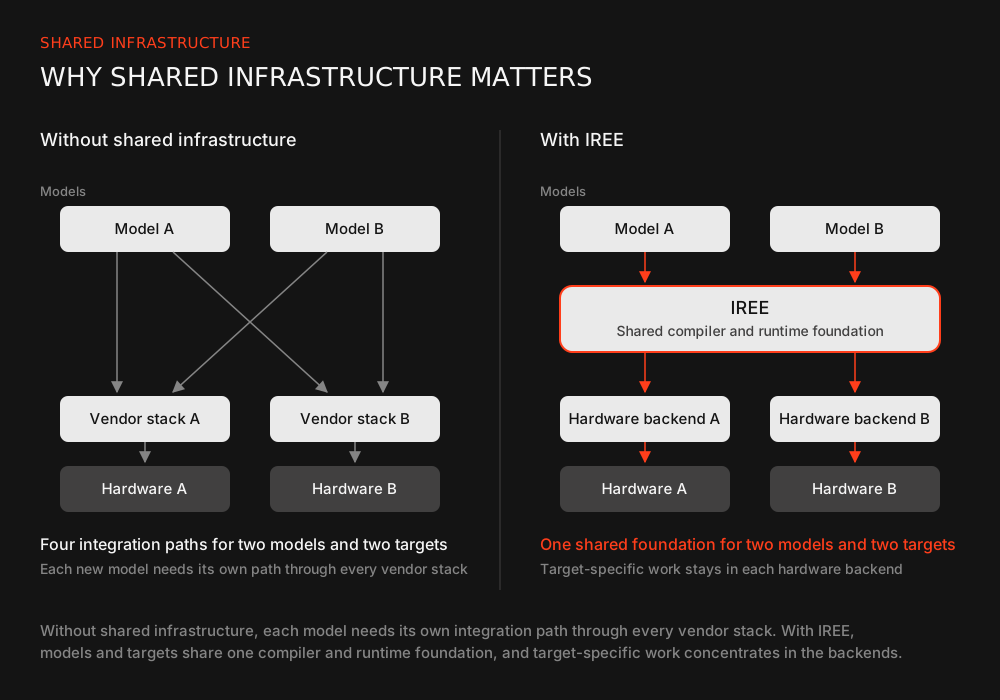
Our work with IREE builds on an established commitment to the project. We use MLIR and IREE as the foundation for the edge AI deployment infrastructure we’re building, to make it easier to deploy AI across different hardware while reducing repeated integration work as models and hardware evolve.
Our engineers contribute to IREE, with more than 1,000 Roofline contributions recorded by LFX Insights over the past year. We also use IREE in real hardware deployments, organize and participate in community meetings, and contribute major technical capabilities to the project, including compiler support for Mixture-of-Experts (MoE) models.
We’ll continue contributing engineering work to IREE and helping to grow the IREE ecosystem. We want to encourage broader participation from semiconductor and IP companies, research organizations, and technical contributors working on AI deployment infrastructure.
Why IREE matters for edge AI
IREE is the most scalable deployment infrastructure for edge AI across rapidly changing models and increasingly diverse target hardware. It can import models from frameworks including JAX, ONNX, PyTorch, and TensorFlow, then compile them for a range of supported operating systems, processor architectures, and accelerators through a common compiler and runtime foundation.
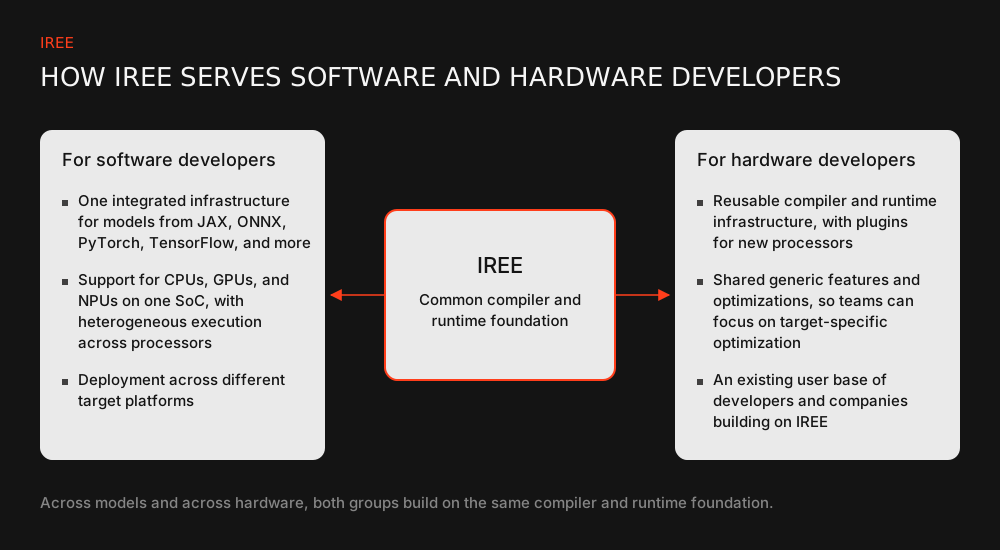
For software developers, IREE reduces the need to use a different vendor-specific deployment toolchain for every hardware target. Hardware backends provide target-specific code generation and optimization, so application teams can focus on the product rather than manually adapting models for each processor.
For hardware developers, IREE provides a shared compiler and runtime foundation that can be extended to support new processors. Compiler plugins can add new targets and dialects, while hardware abstraction layer drivers connect compiled programs to devices at runtime. New hardware still requires target-specific enablement, but the surrounding model-import, compiler, and runtime infrastructure can be reused rather than rebuilt from scratch.
How we want to contribute to IREE’s future
We want to strengthen IREE as shared infrastructure for deploying AI across CPUs, GPUs, NPUs, and heterogeneous systems.
“We’re increasing our engineering investment in IREE, not only by contributing code, but by taking on more responsibility for reviewing pull requests and maintaining areas of the project. A healthy open-source project needs engineers to help carry the ongoing maintenance work as well as contribute new features. We’re committing more Roofline engineering time to that ongoing effort, and we hope more contributors will join us in carrying it forward.”
— Maximilian Bartel, CTO at Roofline and Chair of the IREE Technical Steering Committee
Broader participation is an important part of strengthening IREE. We want more semiconductor and IP companies, research organizations, engineers, and researchers involved in the project, bringing new hardware requirements and technical expertise into the community.
A wider contributor and maintainer base helps IREE reflect more real hardware requirements, spreads the work of solving common deployment problems across the ecosystem, and keeps the project useful across different processors, products, and commercial interests as AI deployment requirements evolve.
Who governs IREE
Roofline contributes to IREE alongside other organizations and individual developers. Maximilian’s role as TSC Chair operates within the project’s existing governance structure, with technical decisions made through the TSC’s established processes.
IREE remains an open-source, sandbox-stage project within the LF AI & Data Foundation. The IREE Technical Steering Committee oversees the project’s technical direction under the IREE Technical Charter, and TSC meetings are open to everyone.
Our CTO, Maximilian Bartel, is serving as Chair of the TSC. The Chair presides over TSC meetings and helps coordinate the committee’s work, but technical oversight remains with the TSC rather than with Roofline or the Chair individually. The TSC elects its Chair from within the project’s governance structure.
Developers can participate through IREE’s GitHub repositories, issues, technical discussions, and community channels. Engineers and organizations can contribute code or documentation, join technical discussions, and help maintain areas of the project.
What our investment in IREE means for our customers and partners
Our open-source work and our commercial deployment work use the same underlying compiler and runtime foundations.
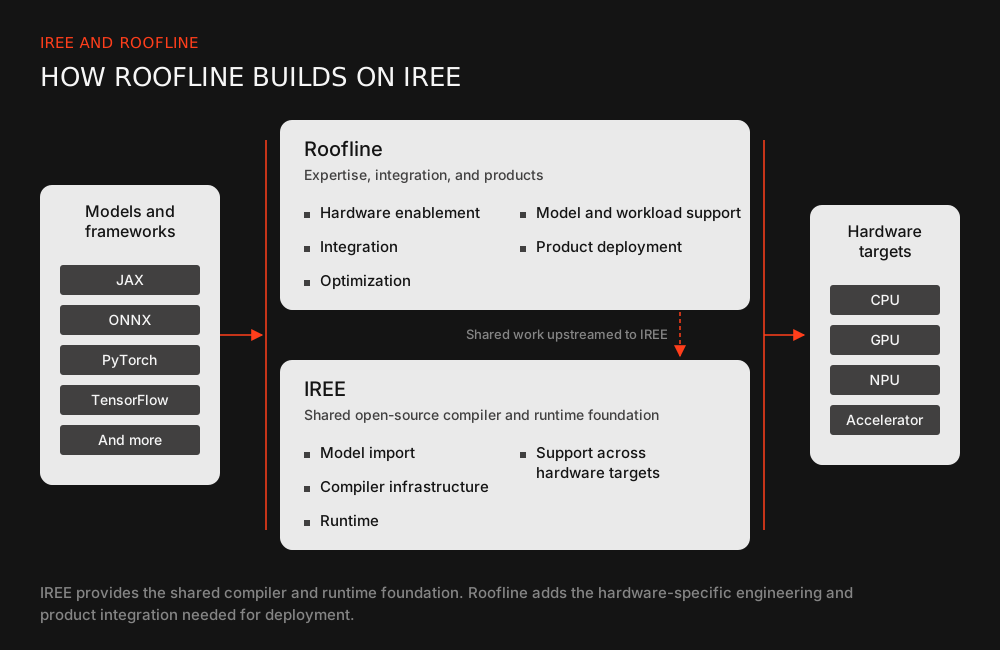
When we solve a deployment problem that belongs in shared infrastructure, the underlying capability can strengthen the common foundation rather than remaining isolated within one hardware integration. When other IREE contributors improve shared compiler and runtime infrastructure, we can build on those improvements too.
The practical benefit is less repeated generic engineering as models and hardware evolve.
IREE provides the shared compiler and runtime foundation for deploying AI across different hardware targets. Roofline turns that foundation into product-ready deployment infrastructure through hardware enablement, integration, and the validation and testing of the models and targets our customers need.
Help build the next stage of IREE
IREE already has an active contributor community, open technical governance, and a growing role in AI deployment infrastructure.
We want more engineers and organizations working on compilers, runtimes, AI hardware, and model deployment to participate in the project, so IREE can reflect a wider range of real deployment requirements and remain useful across different hardware and use cases.
There are several ways to get involved. You can contribute code or documentation through the IREE GitHub repository, open or respond to issues, join technical discussions, attend community and TSC meetings, or help maintain an area of the project. Organizations can also bring new hardware requirements, deployment challenges, and engineering experience into the community.
IREE will be stronger if the people building AI hardware and deployment software help shape the shared infrastructure they depend on. We want to make it easier for more engineers and organizations to contribute, collaborate, and help IREE evolve with the models, hardware, and deployment requirements still to come.
If you have questions, ideas, or want to get involved, join the conversation through IREE GitHub Discussions or the IREE Discord. You can also take part in community meetings to discuss technical work, project priorities, and areas where contributors can help.